I Used Toggl for Two Years to Track My Life. Here's Why I Stopped.
Toggl is the best work time tracker on the market. It's also the wrong tool for tracking your life. Here's what I learned after two years of trying to force it.
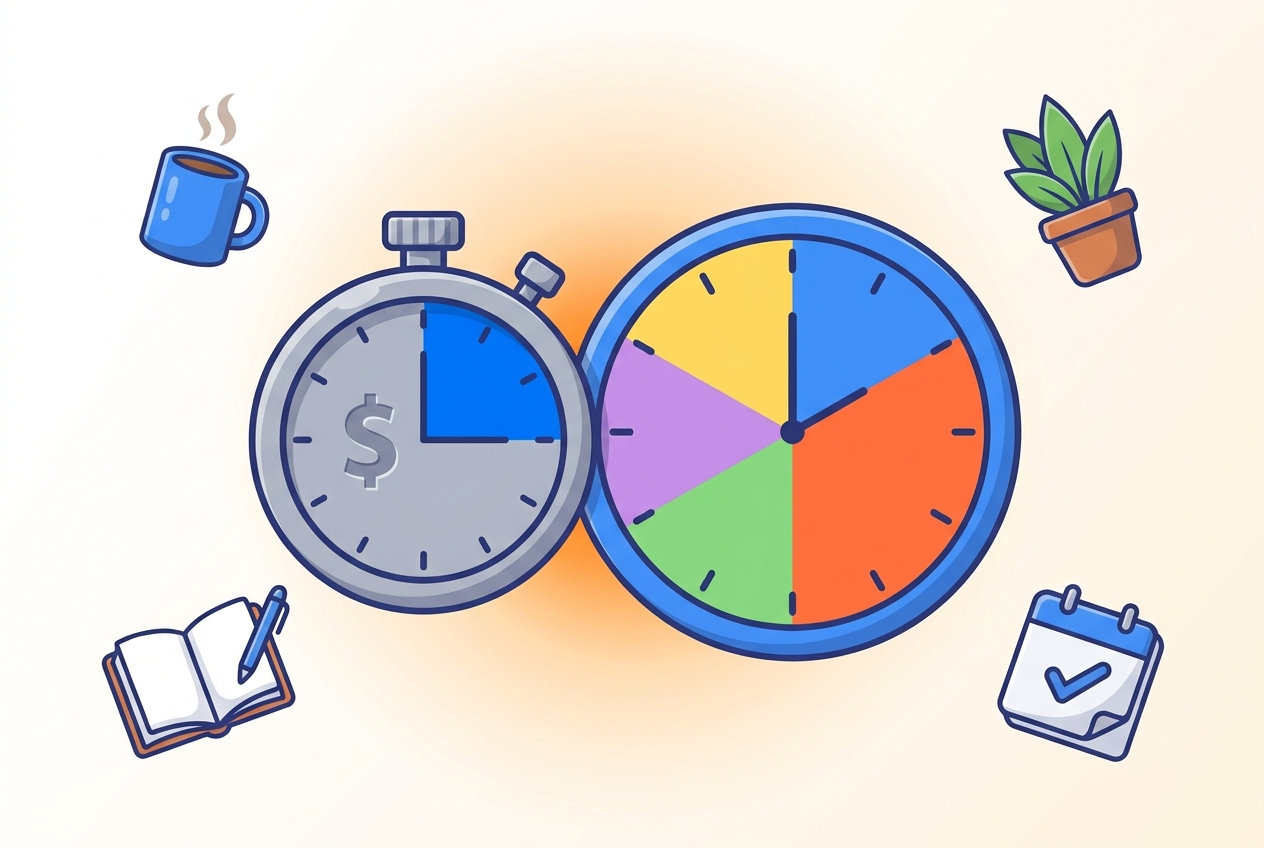
For about two years I tried to use Toggl Track as a tracker for my whole life, not just work. I'd set up "projects" for sleep, exercise, reading, time with my kids. I'd tap the big green button when I started a workout and tap it again when I stopped. I took the tool people recommend for freelancers and consultants and tried to bend it into a life picture.
It worked — sort of. I got data. I learned that I slept less than I thought and read more than I thought. But every month it got a little harder to use, and after two years I gave up and built something else. This is a post about why.
If you're currently using Toggl for personal time tracking and it feels like you're fighting the tool, that's not your fault. Toggl is a great piece of software aimed at a completely different problem than yours. Here's what I ran into, and what I'd look for instead.
What Toggl Is Actually Designed For
Before the complaints, a real compliment: Toggl is probably the best timer in its category. The desktop app is fast. The keyboard shortcuts are good. The reports export cleanly. It's the tool I'd pick in a heartbeat if I ran a consulting agency and needed to bill clients by the hour.
That last sentence is the whole issue. Toggl is built for billable-hour workflows. The entire product — projects, clients, tags, rates, invoices, detailed reports — assumes you're tracking time so you can charge money for it or explain it to a manager. The data model is: "this block of minutes belongs to Client A's Project B." That's a perfect model for freelance work. It's a strange model for your weekend.
The second you stop tracking billable work and start tracking your life, every one of those features becomes dead weight or a source of friction.
Problem 1: The Project-and-Client Model Doesn't Map to Life
In Toggl, the top-level unit is a project (usually attached to a client). Projects are what you pick when you start a timer. So if you want to track "Sleep," you create a project called Sleep. "Exercise" becomes a project. "Reading" becomes a project. "Time with kids" becomes a project.
This works for a week. Then you realize your life doesn't fit into a flat list of 40 projects. Sleep has a different meaning than Exercise has a different meaning than Work. In your head, they group into categories — Health, Family, Work, Learning, Rest. But Toggl doesn't have that concept. It has clients, which are supposed to be actual customers, not life domains.
You can fake it by using clients as pseudo-categories ("Client: Health, Project: Exercise"). I did this. It looks absurd in every report, and every new feature Toggl ships — invoicing, team dashboards, billable rates — assumes your clients are people who pay you money, not abstractions representing the balance of your life.
What I actually wanted: a first-class concept of categories, with activities grouped under them automatically. Sleep lives inside Rest. Exercise and Meditation live inside Health. Deep work and Email live inside Work. I want to see "35% of my week was Health" without manually rolling up a dozen projects. Toggl doesn't offer that because it isn't the tool's job.
Problem 2: Start-Stop Tracking Leaves Holes in Your Day
Toggl's model is start-stop. You hit the button, the timer runs, you hit stop. Between entries, nothing is being tracked — the tool is idle.
For billable work this is correct. You don't bill clients for the ten minutes you spent in the kitchen. But for life tracking, the idle gaps are exactly the interesting part.
At the end of a Toggl week I'd pull up reports and see something like:
- Work: 38 hours
- Exercise: 4 hours
- Reading: 2 hours
And the rest of the week — roughly 124 hours — was... nothing. Empty. Unlabeled. Which is wrong, obviously. I was doing something during those 124 hours. I was commuting, cooking, eating, scrolling, sleeping, spending time with my family. But I hadn't started a Toggl timer for those activities, so they didn't exist in the data.
The whole point of tracking your life is to see where it actually goes. A tracker that accounts for 27% of your week is not giving you a life picture. It's giving you a Swiss-cheese picture of your "notable" hours.
What I actually wanted: continuous tracking, where every minute belongs to some activity, even if that activity is "Unclassified" or "Scrolling" or "Zoned out." The default should be the tool knowing what you're doing at all times, not the tool waiting for you to announce it. For more on this see How to Track All 24 Hours of Your Day.
Problem 3: You Can't See Life Balance
Toggl's reports are built for invoicing. You get hours per project, hours per client, billable vs non-billable, a detailed export for your bookkeeper. Every chart is about how many hours and to whom.
What's missing is any view that asks: "across all my time this week, how did my life break down?" A simple 100% stacked bar — Work 30%, Sleep 33%, Health 7%, Family 15%, Rest 15% — doesn't exist in Toggl. It can't exist, because Toggl doesn't think of your time as a 100% pie. It thinks of it as a collection of billable fragments on a blank canvas.
For a freelancer, that's fine. The only pie that matters is the billable one. For a person trying to answer "is my life balanced?" — the question I actually had — Toggl cannot show you the answer, because the data model rejects the question.
What I actually wanted: a balance view. A single screen that shows me, proportionally, where my week went across categories. Not hours. Not dollars. Percentages of my life. I wanted to look at that picture, notice that Health was 4%, and decide what to do about it. See Where Does My Time Go? for more on why this matters.
Problem 4: Goals Are Built Around Deadlines, Not Rhythms
Toggl does have a goals feature, mostly around project completion or billable targets. "Hit 40 hours on Project X this month." Useful if you run a business.
Life rhythms don't work that way. The goals I wanted were things like:
- "At least 5 hours of exercise per week"
- "At least 7 hours of sleep on weekdays"
- "At most 10 hours per week of social media"
- "At least 3 hours of reading per week, every week"
These aren't one-shot project deadlines. They're recurring rhythms tied to periods of life — daily, weekday, weekend, weekly — that either hold or don't hold every cycle. Toggl's goal concept doesn't really map to that. You can approximate it with reports and spreadsheets, and I did, but every week you're pulling data out, grinding it in Excel, and writing yourself a verdict. It's not a feature of the tool; it's a workflow you maintain around the tool.
What I actually wanted: goals that understand life rhythms. A goal attached to an activity, with a period (daily, weekday, weekend, weekly, monthly, custom), that the app checks automatically. More on this in Time Goals That Actually Work.
Problem 5: Fixing Boundaries Is Painful
In real life, you forget to start the timer. Or you forget to stop it. Or you pause to make a coffee, never hit pause, and now there's a 47-minute "Deep work" entry that's actually 18 minutes of deep work and 29 minutes of coffee plus scrolling.
Toggl lets you edit entries. Every tracker does. But the interaction is clunky for the most common case — "the boundary between these two entries is wrong; move it." You end up editing both entries separately, doing arithmetic in your head, typing in new times. Five times a day.
After a while, you just stop correcting. The data drifts. You trust the tracker less. You start asking why you're doing this at all.
What I actually wanted: a boundary drag. Two adjacent entries meet at a line. Grab the line, move it, both entries update at once. It's a two-second interaction instead of a 30-second one. It's also the difference between keeping the data honest and giving up.
Problem 6: No Integrated Pomodoro
I use pomodoros for writing and for work I'm avoiding starting. Toggl has no built-in pomodoro. There are browser extensions that claim to bolt one on, but the result is always the same: two timers running, two apps to check, two sources of "what activity am I on right now," and inevitable drift.
I covered this at length in You Don't Need a Second App for Pomodoro, so I'll keep it short here. If you want pomodoro and time tracking to be the same workflow — one activity, one countdown, automatic switch to break — Toggl can't do it natively. You'll end up running two apps and manually reconciling them, which is exactly the tax pomodoro was supposed to save you from.
Problem 7: The Pricing Is for a Different Audience
Toggl's free tier is generous for a solo user — timer, basic reports, most features. But the pricing page makes it clear who the paying customer is: teams. Starter is $9/user/month, Premium is $18/user/month. Every feature upgrade is about team scale.
For a single person tracking their own life, paying team prices to unlock personal features you need (like summary exports or custom reports) feels like paying the wrong bill. The tool is pricing you out of use cases it wasn't built for in the first place. Fair enough — that's Toggl's business model. It's just not your business model.
What I actually wanted: full tracking, free. If I'm tracking my own life, there is no upsell path to a team plan; it's just me, and the tool should either work for me or not.
Who Should Still Use Toggl
After all that, I want to be clear: Toggl is excellent. You should use it if:
- You're a freelancer, consultant, or agency who bills by the hour.
- You run a team and need shared timesheets.
- You track time primarily so you can produce invoices or client reports.
- You want the fastest, most polished billable-hour timer on the market.
If any of those describe you, don't switch. Toggl is the right tool. Everything it does well is exactly what you need.
Who Should Look Elsewhere
You should look elsewhere if:
- You want to track your whole life, not just billable work.
- You want a view of your category breakdown, not a list of billable hours.
- You want continuous 24-hour tracking, not start-stop around "real" activities.
- You want goals tied to life rhythms — daily sleep targets, weekly exercise minimums.
- You want integrated pomodoro without running a second app.
- You want the tracking free, because you're one person, not a team.
That's what I ended up building — Timetracker.live, a free life-balance time tracker with categories, hierarchical activities, continuous tracking, built-in pomodoro, and goals that understand weekdays vs weekends. It's the tool I wished I had during those two years of fighting Toggl.
If you want the point-by-point spec comparison instead of the story, that's on /vs/toggl.
The Real Lesson
I don't regret the two years with Toggl. It taught me what tracking could feel like when the tool is sharp and fast, and it taught me exactly which features were built for someone else. The mistake wasn't using Toggl. The mistake was assuming "time tracker" meant one category of tool.
Work time tracking and life time tracking are two different products. They look similar — both have timers, activities, reports — but the underlying model is different enough that forcing one to do the other leaves you in a weird permanent friction. If Toggl feels like it's fighting you for personal use, you're not doing it wrong. You're using a spoon to eat soup that wants a bowl.
Pick the tool that matches the question you're asking. If the question is "how many hours should I bill this client?" — Toggl. If the question is "where is my life actually going?" — something else.
Create a free Timetracker account if you want to try the life-tracker version. Or don't — either way, stop forcing Toggl to do a job it was never built for. Why Time Tracking Fails covers the other common reasons people give up on tracking, and why the tool choice is half the battle.
Related articles
How to Do a Time Audit You'll Actually Finish
Most time audits die on day three, killed by the alarm-and-notebook method. Here's a two-week version that survives contact with a real life, plus the categories to use and what to look for at the end.
You Don't Need a Second App for Pomodoro
If you already have a time tracker running, why are you opening a second app for your pomodoro? Here's what integration looks like — and why it matters.