Where Does My Time Go? How to Finally Get the Answer
Feel like time slips away but can't explain where? Here's how to find out where your time actually goes — with a simple tracking method anyone can start today.
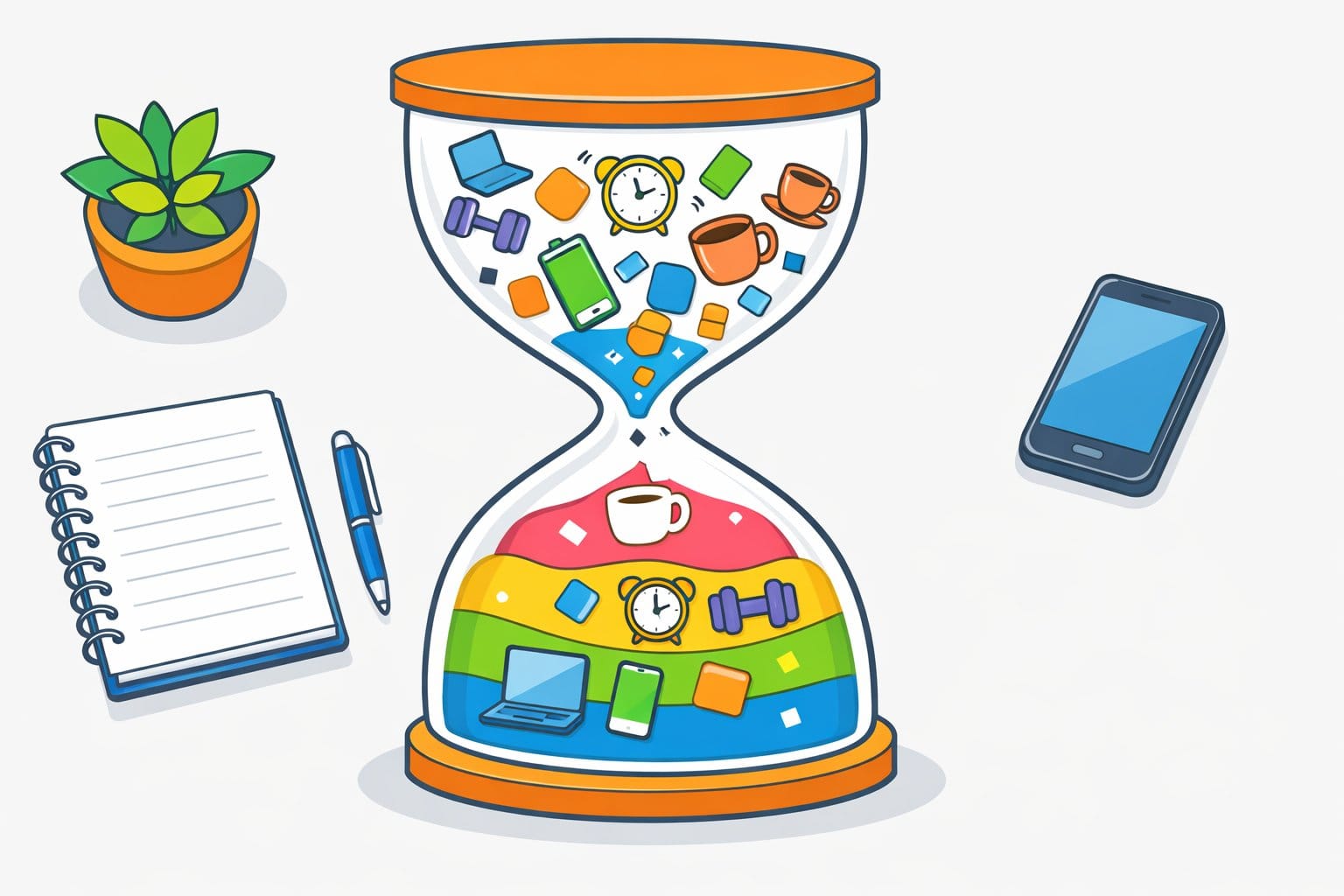
You get to Friday evening and think: where did the week go? You were busy every day. You barely had free time. But when you try to list what you actually accomplished — what you spent those 112 waking hours on — the picture is fuzzy. Meetings, sure. Some work. Chores. But the rest? It just... evaporated.
This isn't a productivity problem. It's a visibility problem. You don't know where your time goes because you've never looked.
The Feeling Everyone Recognizes
"Where does my time go?" is one of those questions that hits different at 11 PM on a Sunday. You planned to exercise three times this week — you did it once. You wanted to read more — didn't touch the book. You were going to start that side project — never opened the laptop.
It's not that you're lazy. Your days are full. The problem is that they're full of things you can't quite name. Small tasks. Transitions. Scrolling. Waiting. Half-started activities that blur together into a sense of "busy" without a clear record.
And without a record, you're making decisions about your time based on feelings, not facts. That's like budgeting your money without checking your bank account.
Why Your Brain Is Bad at Tracking Time
Before blaming yourself, understand something: humans are genuinely terrible at estimating where time goes. Research in cognitive psychology consistently shows that we:
- Overestimate time spent on unpleasant tasks. A 30-minute commute feels like an hour. One long meeting makes the whole day feel "wasted."
- Underestimate time spent on enjoyable activities. Two hours of scrolling social media feels like "a few minutes." A TV binge feels like "just one episode."
- Forget transitions entirely. Getting ready, commuting, settling in, winding down — these gaps between activities can total 2-3 hours per day, but they're invisible in memory.
- Compress routine days. If Tuesday and Wednesday look similar, your brain merges them. By Friday, you have no idea what happened on either day.
This isn't a personal failure. It's how memory works. The only fix is to stop relying on memory and start recording.
The Simple Method That Works
You don't need an elaborate system. You don't need to track every minute perfectly. You need one habit: name what you're doing when you switch activities.
That's it. When you stop working and start cooking, note it. When you stop cooking and start watching TV, note it. When you go to bed, note it. Each switch takes a few seconds.
After even one week of this, you'll have a dataset that answers "where does my time go?" with actual numbers instead of guesses.
What you need to track
You don't need fifty categories. Start with 5-7 categories that cover your whole day:
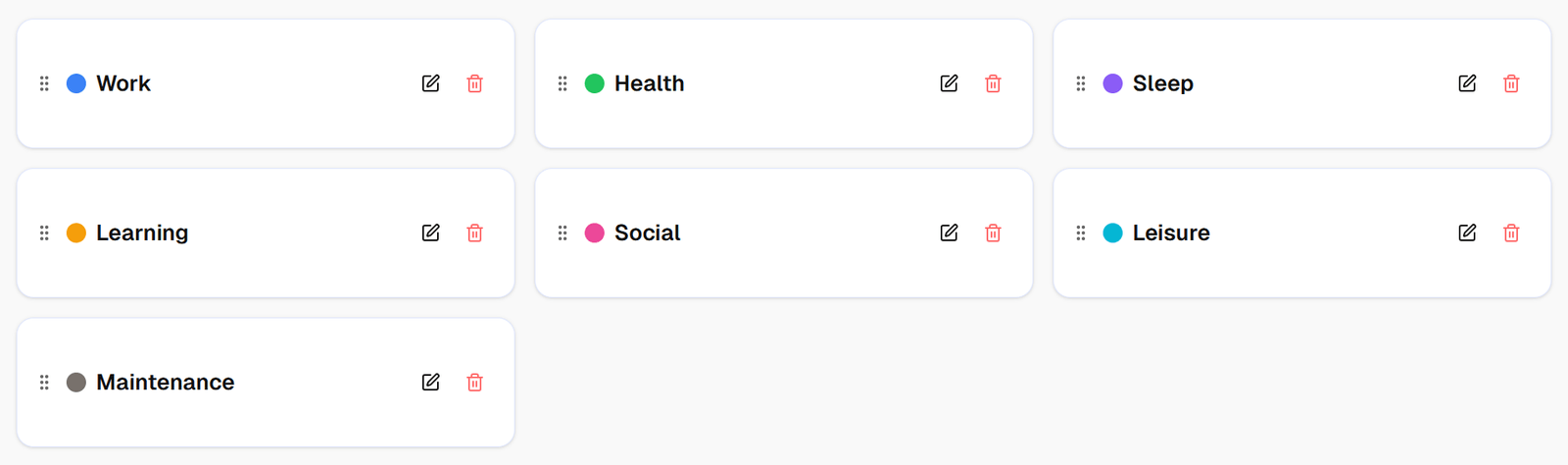
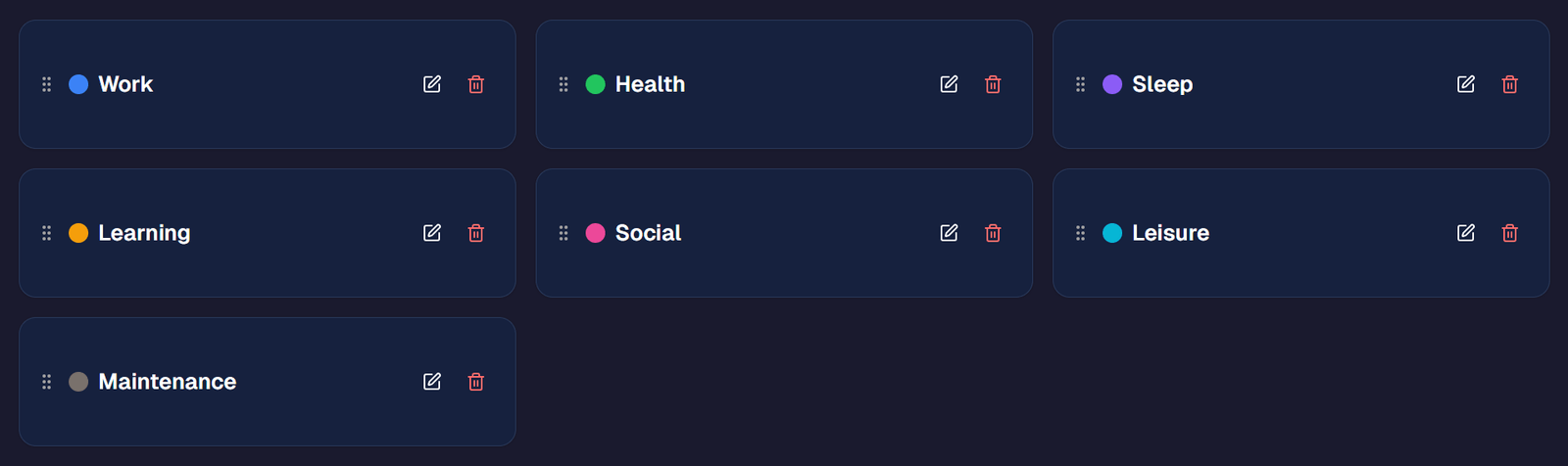
- Work — job, career tasks, side projects
- Health — exercise, cooking healthy food, medical
- Sleep — nighttime sleep and naps
- Learning — reading, courses, skill practice
- Social — family, friends, relationships
- Leisure — entertainment, hobbies, relaxation
- Maintenance — chores, commute, errands, hygiene
Under each category, add a few specific activities. "Work" might have "Deep work," "Meetings," and "Email." "Health" might have "Gym," "Running," and "Cooking." You can always add more detail later — start simple.
How the tracking itself works
The best approach is real-time switching. When you change what you're doing, you tap one button to switch the timer.
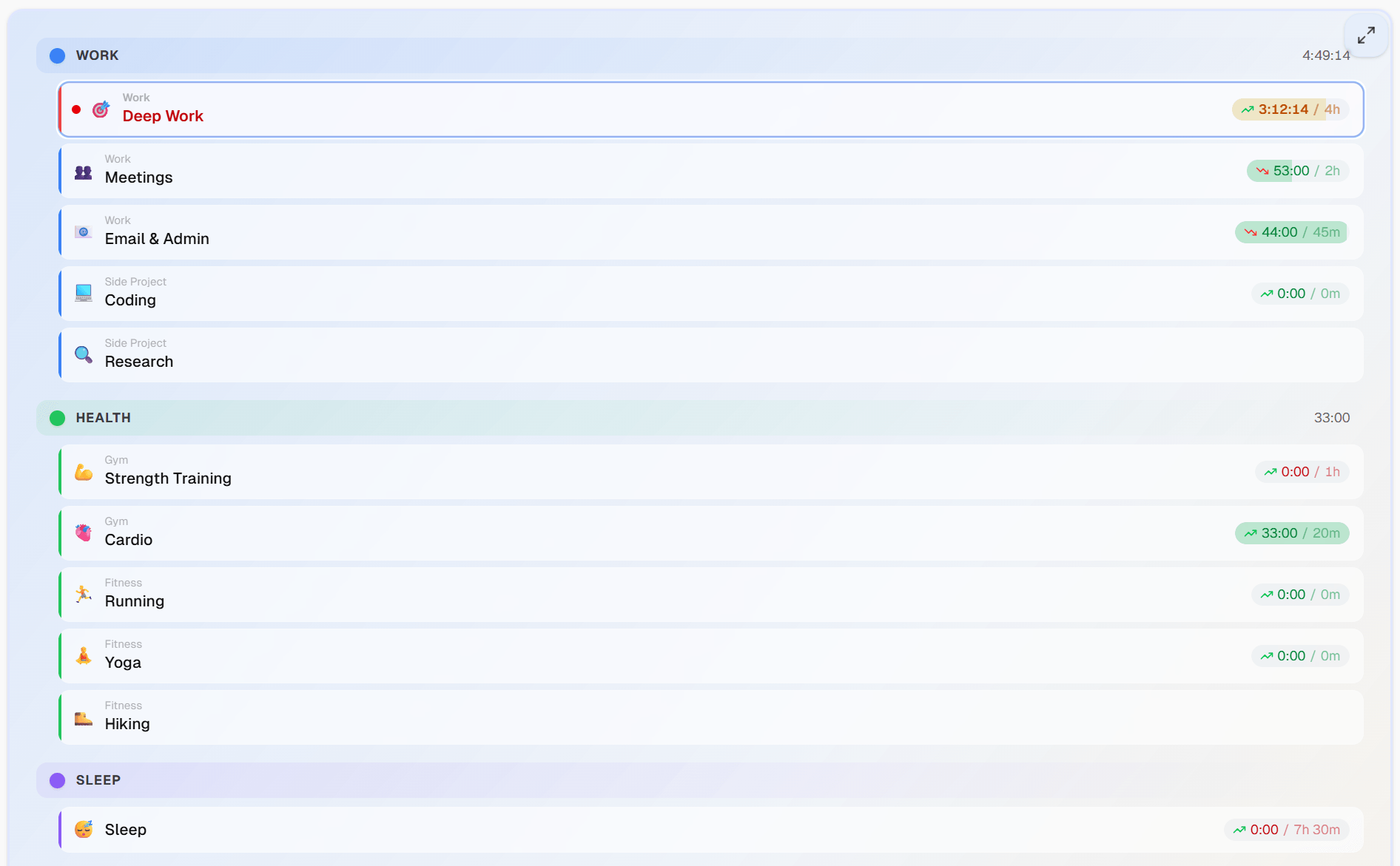
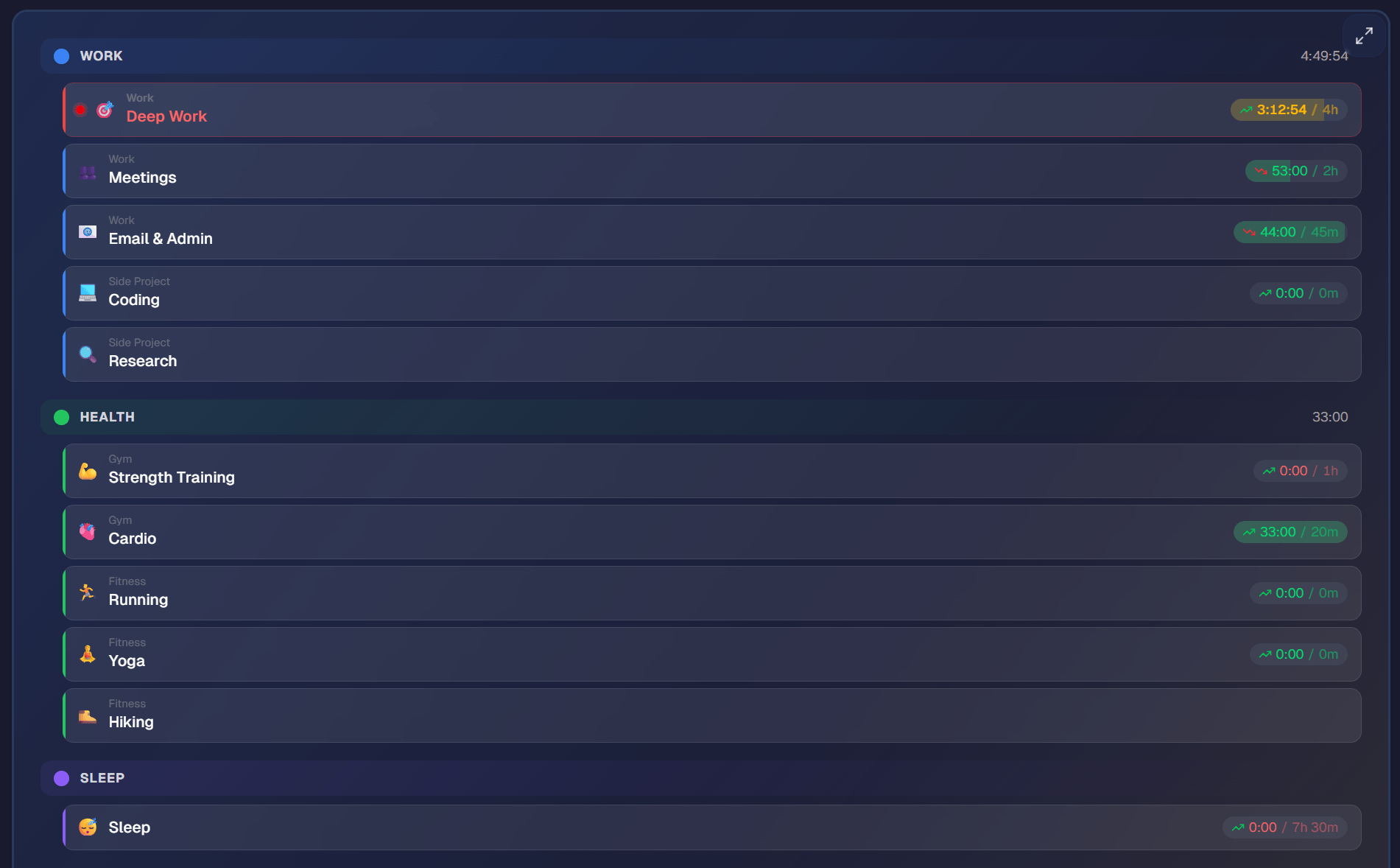
No start/stop. No filling in timesheets at the end of the day. Just a continuous flow: wake up → morning routine → commute → deep work → meeting → lunch → and so on. Every moment is accounted for, and you're always tracking all 24 hours, not just work.
What about when you forget?
You will forget. Everyone does. You'll get absorbed in something and realize two hours later that your timer is still on the previous activity.
This is normal, and it's not a reason to quit. A good tracking tool lets you fix boundaries after the fact. Drag the switch point back to when it actually happened. Forgot to track your entire evening? Add the entries the next morning from memory — even rough entries are far better than no data.
The goal isn't perfect accuracy. It's useful accuracy. Even tracking 80% of your time correctly gives you a dramatically better picture than tracking 0%.
What the Data Actually Reveals
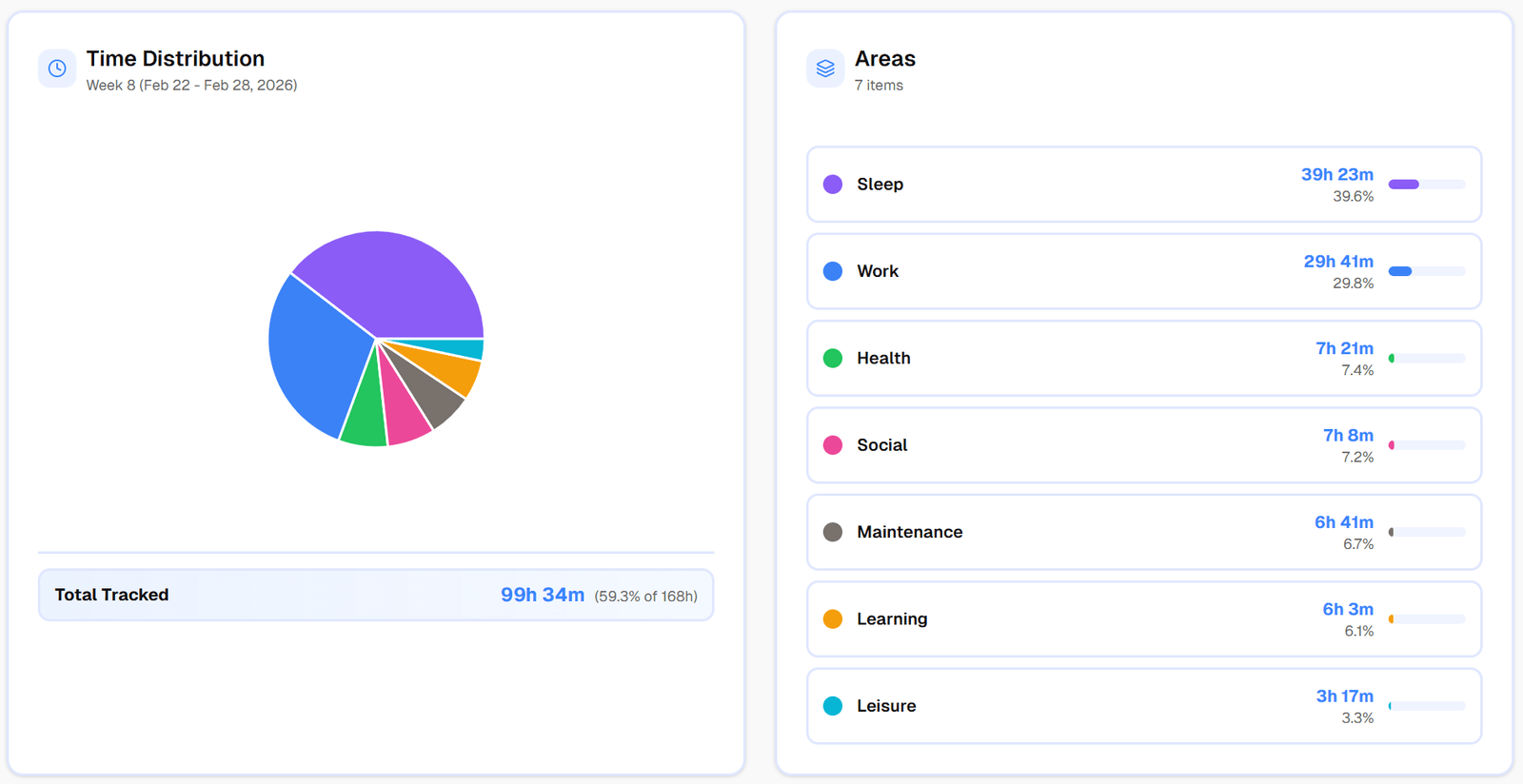
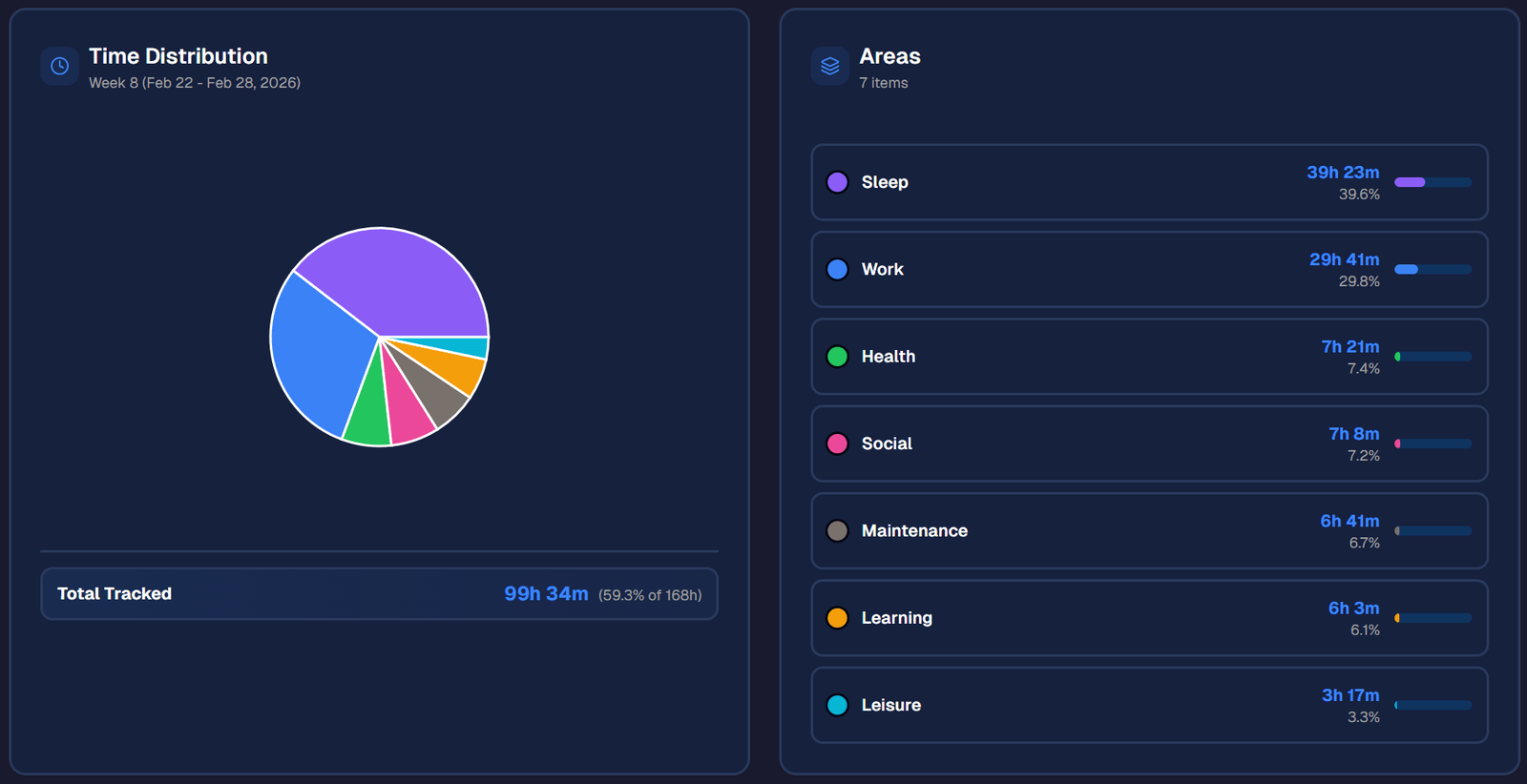
Here's where it gets interesting. After one to two weeks of tracking, patterns emerge that surprise almost everyone:
The maintenance tax
Most people discover that chores, errands, commuting, getting ready, and other "maintenance" activities consume 20-30 hours per week. That's nearly a part-time job spent on things that produce no value, no joy, and no growth. You never noticed because these activities are scattered throughout the day in 15-30 minute chunks.
Seeing this number changes behavior. You start batching errands. You optimize your morning routine. You question whether that 45-minute commute is really worth it.
The leisure surprise
The common complaint is "I have no free time." The data often says otherwise. Many people discover 2-3 hours of daily leisure time they didn't register — short phone sessions, YouTube between tasks, browsing before bed. It's not that you have no free time. It's that your free time is fragmented and forgettable.
Once you see it, you can choose: is this how you want to spend those hours? Maybe yes. Maybe you'd rather consolidate them into something more satisfying.
The sleep inconsistency
You "get 7-8 hours of sleep." Do you? Tracking often reveals a range of 5.5 to 9 hours with an average closer to 6.5. The nights you think you went to bed early, you actually spent 45 minutes on your phone first. The data doesn't lie.
The goal gap
You say health is a priority. Your data shows 2 hours of exercise last week. You say learning matters. Your data shows zero hours of reading. This isn't meant to shame — it's meant to clarify. The gap between what you value and what you do is where the real insight lives.
From Data to Decisions
Knowing where your time goes is useful only if you do something with it. Here's a simple framework:
Week 1-2: Just observe. Don't try to change anything. Track and let the data accumulate. Any conclusions before two weeks are based on too little data.
Week 3: Identify one surprise. Pick the single biggest gap between how you thought you spent time and how you actually spent it. Maybe it's the 3 hours of daily phone time. Maybe it's the 1.5 hours of daily "getting ready." Maybe it's the zero hours of exercise.
Week 4: Set one goal. Not five goals. One. "Exercise at least 4 hours this week" or "Limit social media to 1 hour per day." You can set time goals that actually work — minimum hours for things you want more of, maximum hours for things you want less of.
Month 2 onward: Adjust and add. As the first goal becomes a habit, add another. The data keeps flowing, so you always know if you're drifting.
Why Most People Quit (and How Not To)
The biggest reason people stop tracking isn't boredom or effort — it's perfectionism. They miss a day, feel like the data is "ruined," and give up.
Here's the truth: imperfect data is infinitely more valuable than no data. A week where you tracked 5 out of 7 days still tells you far more than zero weeks of tracking. A day where you estimated some entries from memory is still useful. The trends matter, not the individual minutes.
Other tips for sticking with it:
- Track from any device. If your tracker only works on your phone, you'll skip tracking whenever you're at your computer (and vice versa). Use a tool that works on web, Android, iPhone, Windows, and Mac so you can switch activities from whatever's in front of you.
- Review weekly, not daily. Daily data fluctuates too much. Weekly patterns are where the real insights live. Set aside 5-10 minutes on Sunday to look at your week.
- Don't over-categorize. If deciding which category to pick takes longer than 2 seconds, you have too many categories. Simplify.
- Celebrate the data, not the outcomes. At first, reward yourself for tracking consistently, not for hitting goals. The habit of tracking is what matters most.
The Answer Is Simpler Than You Think
"Where does my time go?" feels like a philosophical question. It's not. It's an empirical one — and the answer is a few taps away.
You don't need to track forever. Even 3-4 weeks of consistent tracking gives you a baseline understanding of your time that will stay with you long after you stop. But most people who try it find they don't want to stop, because the awareness itself changes behavior.
Start tracking for free at timetracker.live. Set up your categories, track for one week, and see the answer for yourself. It might surprise you.
Related articles
How to Do a Time Audit You'll Actually Finish
Most time audits die on day three, killed by the alarm-and-notebook method. Here's a two-week version that survives contact with a real life, plus the categories to use and what to look for at the end.
I Used Toggl for Two Years to Track My Life. Here's Why I Stopped.
Toggl is the best work time tracker on the market. It's also the wrong tool for tracking your life. Here's what I learned after two years of trying to force it.