How to Do a Time Audit You'll Actually Finish
Most time audits die on day three, killed by the alarm-and-notebook method. Here's a two-week version that survives contact with a real life, plus the categories to use and what to look for at the end.


Search for how to do a time audit and you will get the same instructions everywhere. Set an alarm for every 30 to 60 minutes. When it goes off, write down what you were doing. Do this for one to two weeks. Then analyse the results.
It is good advice. It is also the reason most time audits are abandoned by Wednesday.
The method asks you to interrupt yourself twenty times a day, in meetings, while cooking, mid-conversation, and to reconstruct from memory what you were doing before the alarm broke your focus. That is a second job. Nobody keeps a second job for two weeks to satisfy their own curiosity.
This is a version built to be finished.
What a time audit actually is
A time audit is a temporary project with an end date. You record where your hours go for a fixed period, then you look at the record and decide what to change.
That is worth separating from time tracking, which is an ongoing habit, and from time management, which is what you do after you know the answer. An audit is neither. It is a measurement campaign: you run it, you get a number, you stop.
Confusing the audit with the habit is the first mistake. People start an audit intending to track forever, feel the weight of "forever" by day four, and quit. Setting an end date up front removes that weight entirely.
Why the classic method fails
Three specific problems, all fixable.
The alarm interrupts the thing you are measuring. A prompt every 30 minutes does not observe your day, it fragments it. You end up auditing a version of your life that only exists because you were auditing it.
Reconstruction from memory is unreliable. By the time the alarm sounds, you have already lost the last half hour. And memory is systematically biased: we overestimate unpleasant tasks, underestimate enjoyable ones, and forget transitions almost completely. Getting ready, commuting, settling in, winding down — that can total two or three hours a day and it is nearly invisible in recall. We covered that in more detail in Where Does My Time Go?
Nobody defines the categories before starting. Two weeks later you have 200 free-text entries that cannot be added up. "Emails", "email", "inbox" and "replying to Dave" are four rows in your notebook and one activity in your life.
Decide the length first: two weeks
The standard advice says one to two weeks. Our own usage data says the same thing more precisely.
Looking at people who run a genuine audit in Timetracker — enough entries on day one to show real intent, not a look around — the typical run is a little under a week, and three quarters of them are done inside 16 days. Very few go past a month, and the ones who do are not auditing any more. They have become trackers.
That is not a failure of discipline. Two weeks is simply how long it takes to get the answer. By then you have both kinds of weekday, at least one weekend, and enough repetition that a pattern is a pattern rather than an odd Tuesday.
So plan for fourteen days, tell yourself that is the whole commitment, and mean it. If you want to continue afterwards, that is a separate decision made with data in hand.
Set your categories before day one
This is the step that decides whether the audit produces an answer or a pile of notes. Fifteen minutes of preparation, done once.
Work at two levels. A handful of categories — the parts of your life you would actually rebalance — and under each, the activities you would recognise on a calendar.
| Category | Activities |
|---|---|
| Work | Focused work, meetings, email and chat, admin |
| Sleep | Night sleep, naps |
| Health | Exercise, cooking, medical, hygiene |
| Family | Kids, partner, extended family, household |
| Growth | Learning, reading, side project |
| Leisure | TV and streaming, gaming, social media, socialising |
| Logistics | Commute, errands, transitions |
Three rules for the list:
- Between five and eight categories. Fewer and everything lands in one bucket. More and you spend the audit deciding which bucket.
- Include the boring ones. Commute, transitions, hygiene, admin. These are exactly the categories people leave out, and they are exactly where the missing hours turn out to be.
- Include sleep. An audit that covers sixteen hours is not an audit of your day. Sleep is usually the largest single block, and if it is short, that explains more about your week than anything else on the list.
Do not create a category for what you wish you did. If you have not read a book in six months, "reading" is not a category yet. Add it later if it appears.
Running the fourteen days
Record at the switch, not on a schedule. Instead of an alarm every 30 minutes, mark the moment one activity ends and the next begins. This is a smaller ask — a few seconds, several times a day — and it removes the reconstruction problem entirely, because you are recording the present rather than recalling the past.
Do not tidy up as you go. The temptation on day three is to fix Monday's entries. Resist it. Retrospective editing is where honest data quietly turns into the day you wish you'd had. Fix genuine mistakes — a forgotten stop, a wrong activity — and leave the rest alone.
Do not change your behaviour. You will want to. Knowing you are recording it makes the second hour of scrolling feel expensive. If you clean up your habits during the audit, you measure your best behaviour rather than your normal behaviour, and you end up with a plan for a person who does not exist. Behave badly on purpose if you have to. The point of the fortnight is a true baseline.
Expect to miss things. A day with gaps is still a useful day. An audit abandoned because it was not perfect is worth nothing.
What to look for at the end
This is the step almost everyone skips, and it is the whole reason for the exercise. Set aside half an hour on day fifteen.
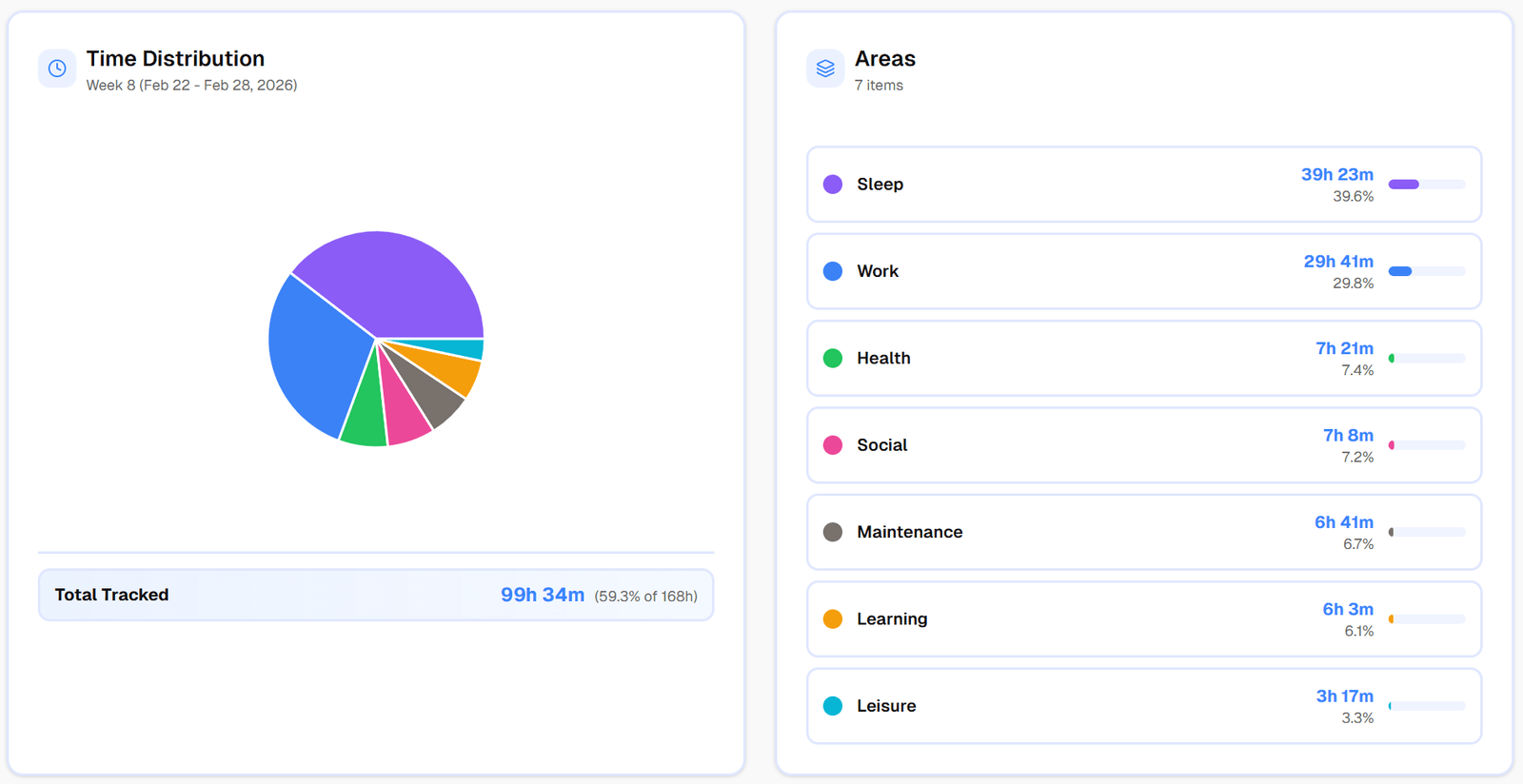
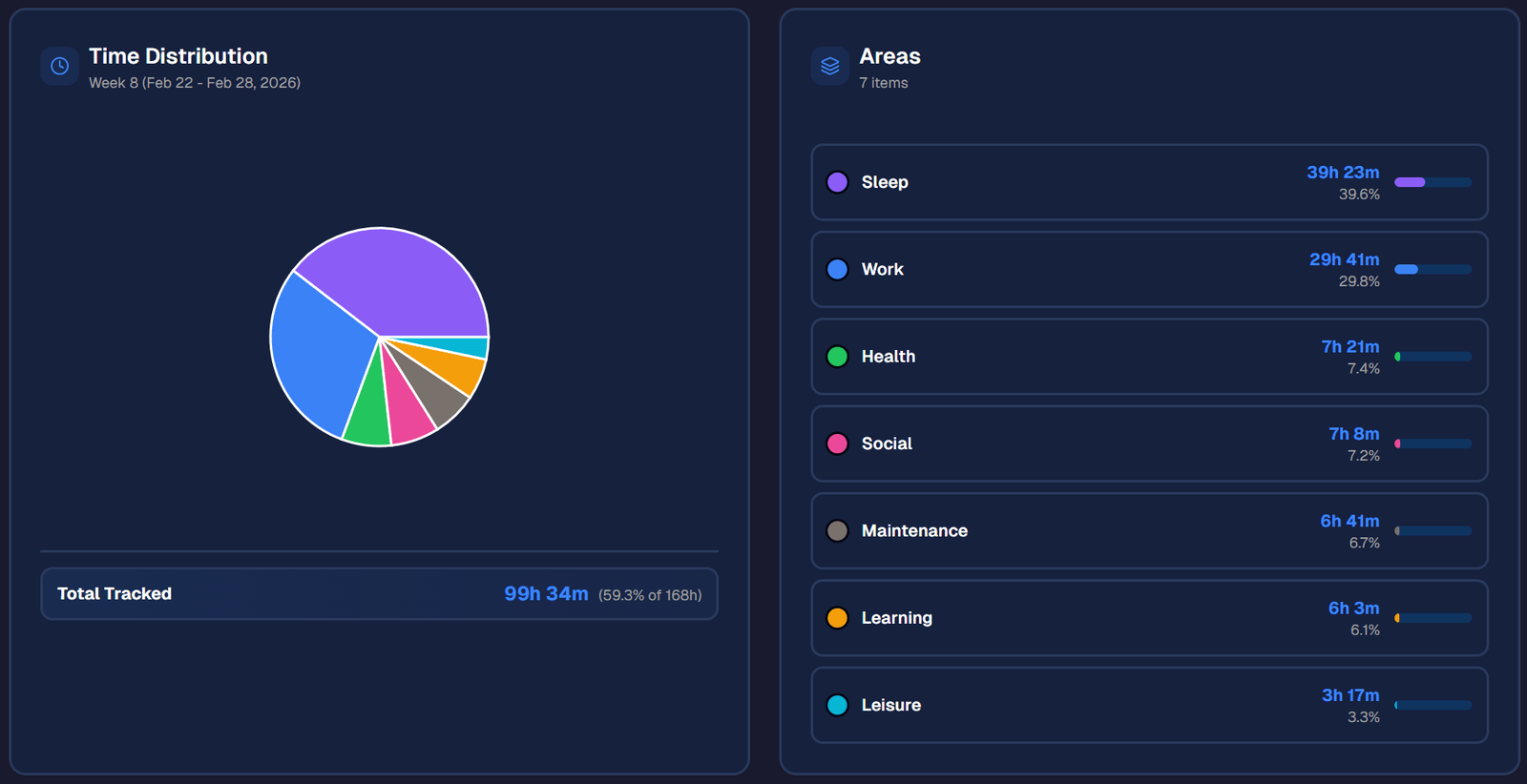
That is what the finished thing looks like: every category ranked by hours, each with its share, and the total set against the hours that actually existed. Note the last number in particular — 99 hours recorded out of 168. The rest is the gap, and the gap is part of the finding.
Compare the totals against your guess. Write down, before you look, how many hours you think went to each category. Then compare. The gap is the finding. It is almost never where people expect: the usual surprises are that focused work is a third of what was assumed, and that transitions and admin are double.
Look at the largest block that is not sleep or work. Whatever it is, it is running your week. Most people have one and cannot name it before the audit.
Look at what got nothing. The categories you deliberately created and that came out at zero or near it are the real result. It is one thing to feel that you never exercise. It is another to see 0h 40m against a fortnight in which you had 168 hours twice over.
Check one weekday against one weekend day. If they look the same, that is a finding too.
Then make exactly one change. Not five. A time audit that produces a seven-point life overhaul produces nothing, because none of the seven survive the month. Pick the largest gap between where your hours went and where you wanted them, and move that one.
Paper, spreadsheet, or an app
All three work. They differ in how much of your energy the recording itself consumes, and energy is the constraint that decides whether you reach day fourteen.
Paper is the most honest and the most likely to be abandoned. There is nothing to set up and nothing to sync, but you must have the notebook with you at every switch, and you must add up two weeks of entries by hand at the end. If your day is mostly at one desk, it is fine.
A spreadsheet solves the arithmetic and creates a new problem: you can only reach it when you are at a computer. Evenings and weekends — the part of the audit most likely to surprise you — are exactly when the spreadsheet is not open.
An app removes both the arithmetic and the carrying problem, at the cost of setting up your categories first. Which you should be doing anyway.
That is what Timetracker is built for. You set up your categories and activities once, tap when you switch, and the totals for the fortnight are already calculated when you get to day fifteen. It runs on Android, iPhone, Windows, Mac, Linux and in any browser, and it syncs between them, which matters during an audit precisely because your evenings and your workdays happen on different devices. Every current feature is free, with no ads.
If the reason your last attempt failed was that recording felt like work, the tool is the part to change.
Common questions
How long should a time audit be? Two weeks. Long enough to cover both kinds of weekday and at least one weekend, short enough that you finish. One week gives you a usable answer if a fortnight feels like too much.
Do I have to track all 24 hours? Yes, if you want the audit to mean anything. Sleep is usually the biggest block in the week, and the hours nobody accounts for are the hours the audit is meant to find. We wrote about the whole-day version in How to Track All 24 Hours of Your Day.
What if I forget for a whole day? Leave the gap and carry on. Do not restart, and do not reconstruct it from memory — an invented day is worse than a missing one.
Should I audit work hours or all of my life? All of it. A work-only audit tells you how you spend the third of your week that is already the most structured. The interesting variance is everywhere else.
Is this the same as time blocking? No, and they belong in that order. An audit records what happened. Time blocking plans what will happen. Planning before you have measured is guessing with a calendar. If you want to set targets after the audit, Time Goals That Actually Work covers what makes them stick.
I lose track of time completely. Will this work for me? It works better, not worse, and there is a version of the method aimed at it. Recording at the switch gives you an external record where an internal sense of elapsed time is unreliable. We wrote about that case in Timetracker for ADHD.
The short version
Set an end date of two weeks. Write down five to eight categories before you start, including sleep and including the boring ones. Record at the moment you switch, not on an alarm. Do not clean up your behaviour or your data while it is running. On day fifteen, compare the totals to what you would have guessed, find the largest gap, and change one thing.
That is the whole method. The hard part was never the analysis — it is getting to day fifteen with a record worth analysing.
Related articles

I Used Toggl for Two Years to Track My Life. Here's Why I Stopped.
Toggl is the best work time tracker on the market. It's also the wrong tool for tracking your life. Here's what I learned after two years of trying to force it.


You Don't Need a Second App for Pomodoro
If you already have a time tracker running, why are you opening a second app for your pomodoro? Here's what integration looks like — and why it matters.